Matric season discountDiscount price R299Regular price R499
How to help your child through matric without adding to the pressure
A practical guide for South African parents: what to say, what never to say, and how to handle bad results, the exam weeks and results day.
- Read it in one evening. Use it tomorrow morning.
- Finals close, or already started? Start at Part Four tonight.
Instant PDF download. Once-off payment, no subscription.
4.6 out of 5 from 30 parent reviews

Instant download
Read it tonight, on your phone or computer.
Made for South African homes
Local exam dates, pass levels and helplines.
Seven printable tools
Made for the fridge, not the bookshelf.
Secure card payment
Processed by Yoco. We never see your card.
Why this guide exists
I first spoke to Claire Thompson, a mother in Durban, because matric was putting real pressure on her household.
She was worried about her daughter’s marks, anxious about whether she was doing enough, and often unsure of what to say when things were not going well. She wanted to help, but sometimes felt that every question about studying only created more pressure.
She found herself wondering whether she should push harder, give her space, or simply stay quiet. She wanted to be supportive without making her daughter feel like she was carrying the weight of her expectations.
After hearing what she was going through, she asked me to build Behind Every Matric around the problems she described: what to say after a bad mark, how to handle the exam weeks, how to create a calmer home, and how to support your child without becoming the “matric police”.
Her daughter went on to finish matric with a 78% average.
That mark is hers, and this guide does not promise marks. What it gives your child is a calmer home and a parent who knows what to say, so they can get on with the work.
This guide was created to help parents feel more confident, calm and prepared during one of the most stressful years of their child’s school career.
From the author of Behind Every Matric
If this sounds like your house, this guide is for you
- You ask “Are you studying?” more than once a day, and you can hear how it lands.
- A bad mark comes home and you do not know what to say first.
- Your child has gone quiet, and “fine” is all you get.
- Most of the fights are about the phone, sleep or friends, not the work.
- Results day is coming and you have no plan for either outcome.
- You lie awake at 11pm wondering whether you are doing enough.
What is inside
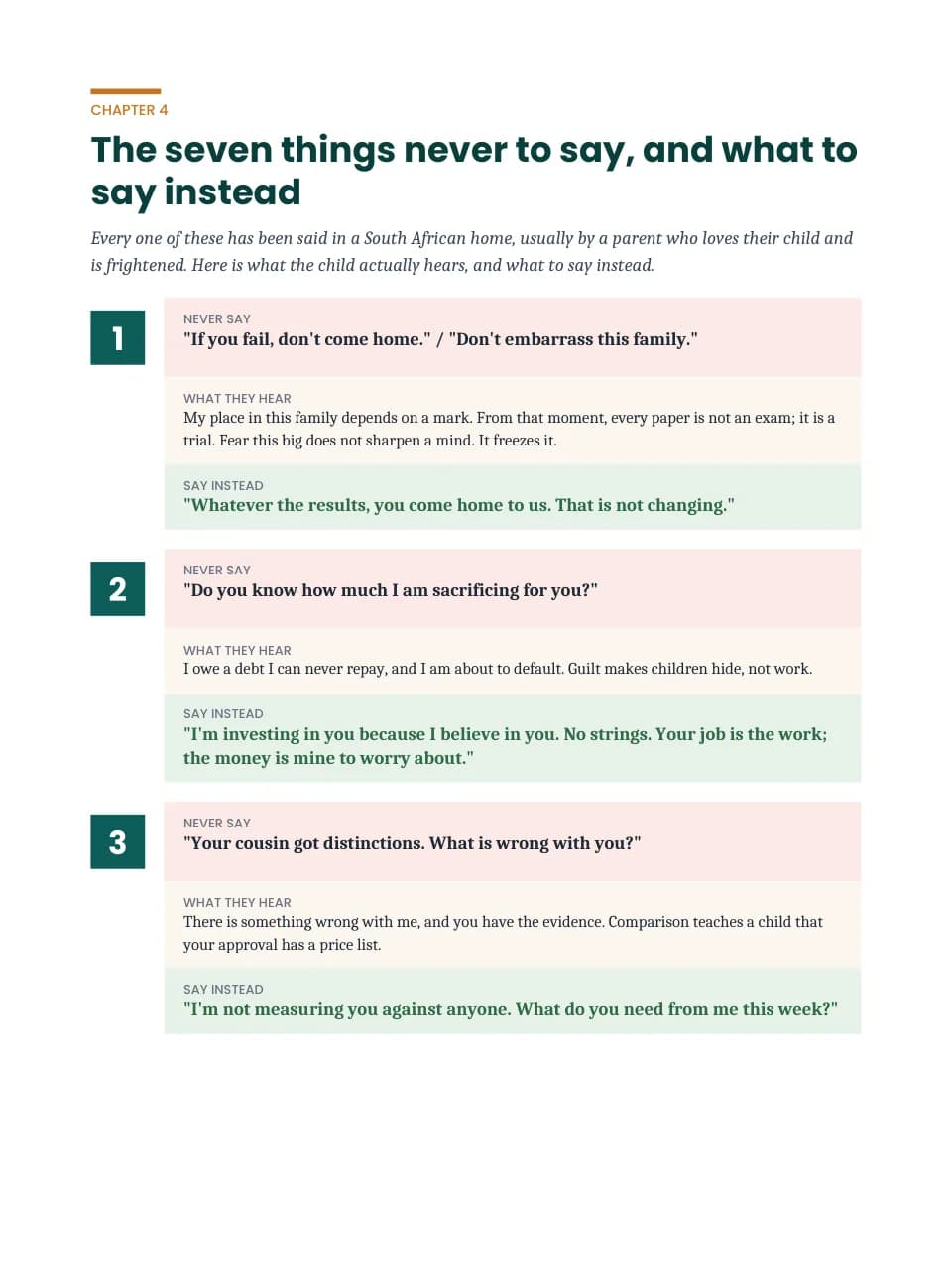
The words to use
Seven things never to say, what your child actually hears, and what to say instead.
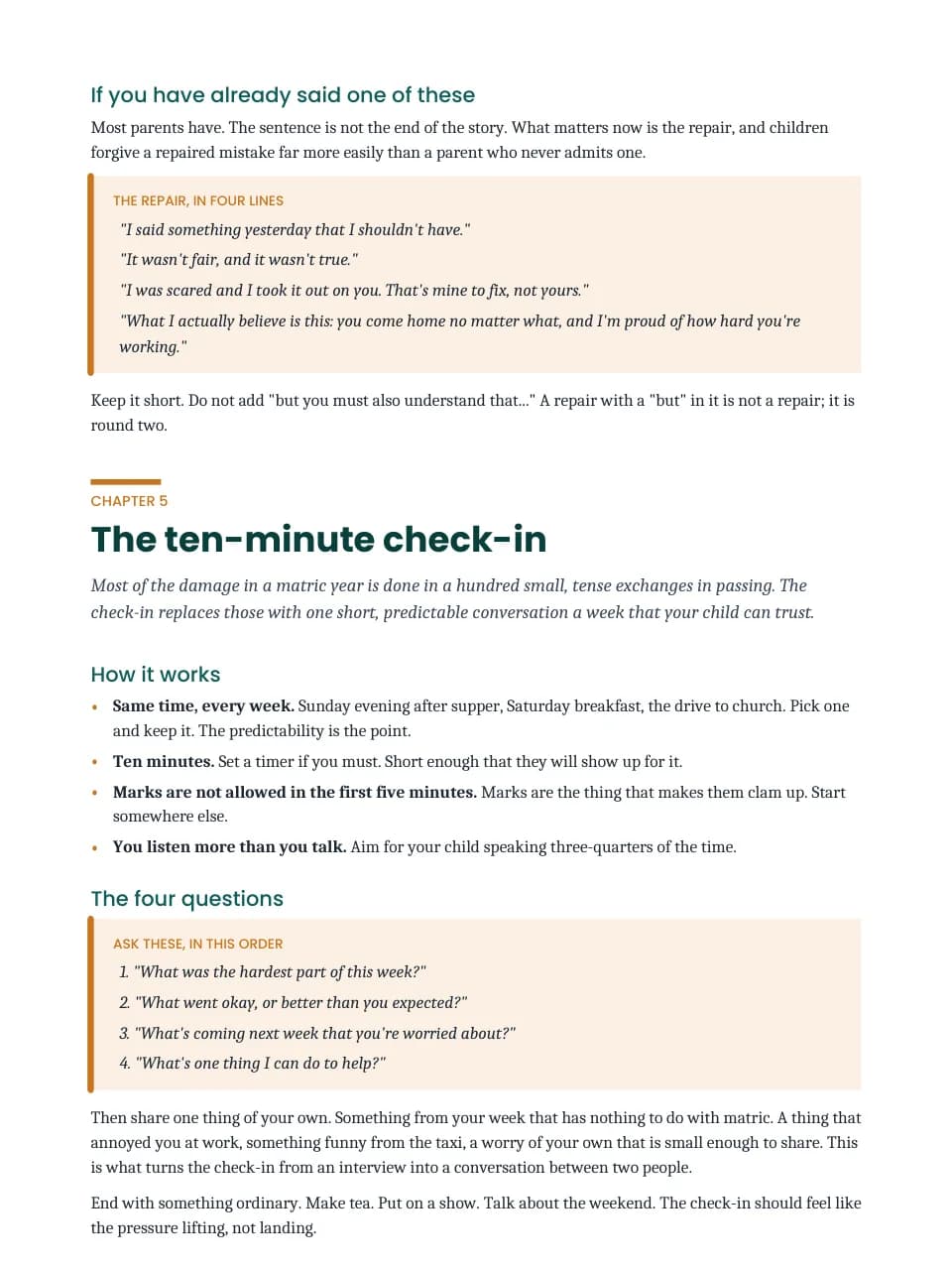
The ten-minute check-in
Four questions, once a week, that get a quiet teenager talking without an interrogation.
A plan for bad results
The 24-hour rule, the first sentence, and three questions that turn a bad mark into a next step.
A calmer home
Agreements for phones, sleep and quiet hours that work even when money and space are tight.
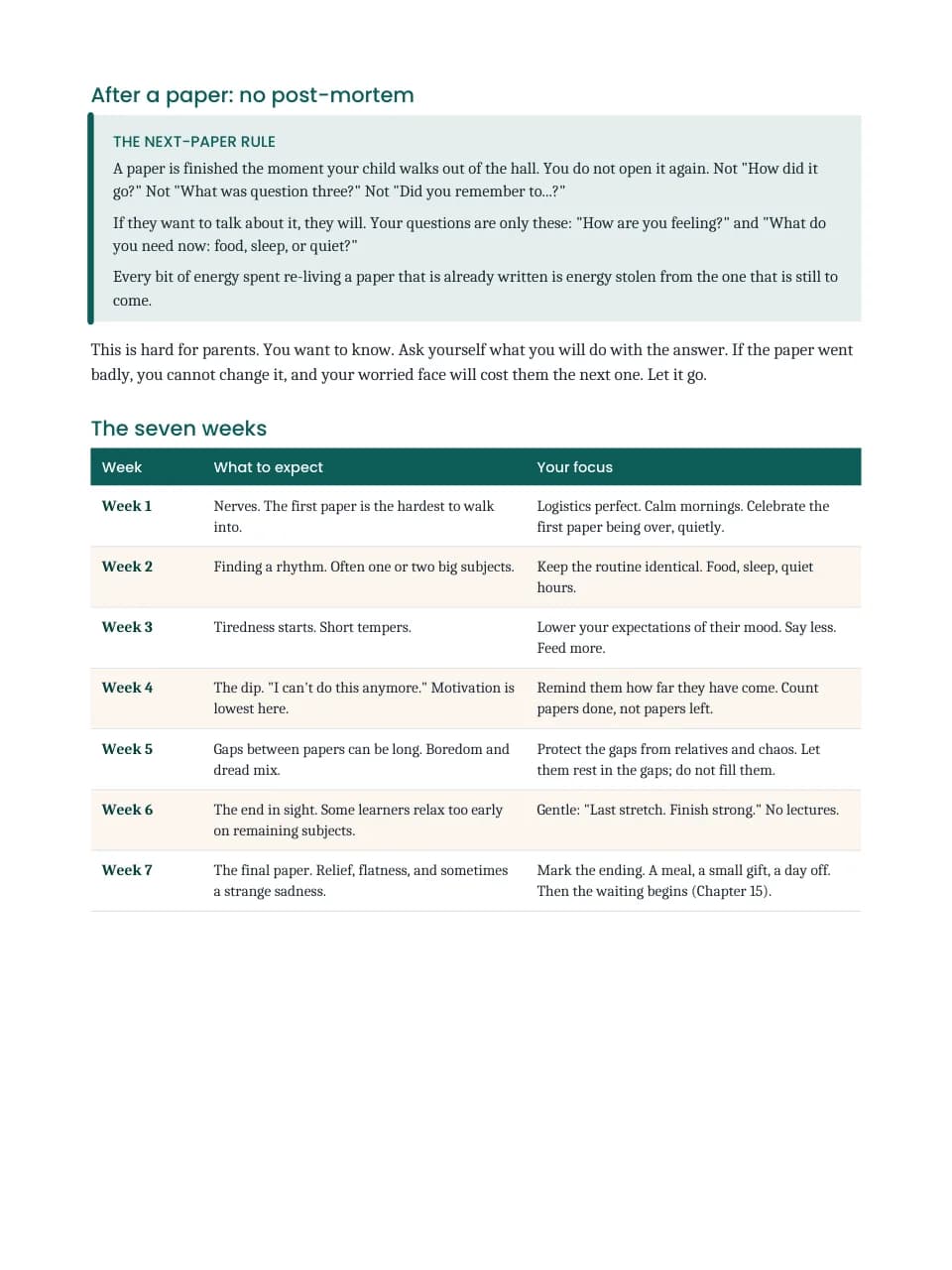
Finals, week by week
Your job in each of the seven exam weeks, from the night before a paper to the walk out of the hall.
Results day, and after
What to say in the first minute, and every option if the results are not what they needed.
20 short chapters in six parts, plus seven printable tools: the check-in card, the home agreement, the finals planner, the results-day plan, the next 30 days planner, the never-say card and the helplines page.
The same worry, said a different way
Most of the pressure parents add comes out of love and fear. The guide gives you the exact words for the moments that matter. Here are three of them.
| Instead of | What your child hears | Try saying |
|---|---|---|
| Instead of“Are you studying?” for the fourth time today | What your child hearsYou don't trust me. | Try saying“What's your plan for today? Is there anything I can take off your plate?” |
| Instead of“It's just an exam. Relax.” | What your child hearsMy feelings are wrong, and you don't understand what this is. | Try saying“It makes sense that you're stressed. What would help right now?” |
| Instead of“Your cousin got distinctions. What is wrong with you?” | What your child hearsThere is something wrong with me, and you have the evidence. | Try saying“I'm not measuring you against anyone. What do you need from me this week?” |
The guide covers all seven, plus a four-line repair for when you have already said one.
A look inside
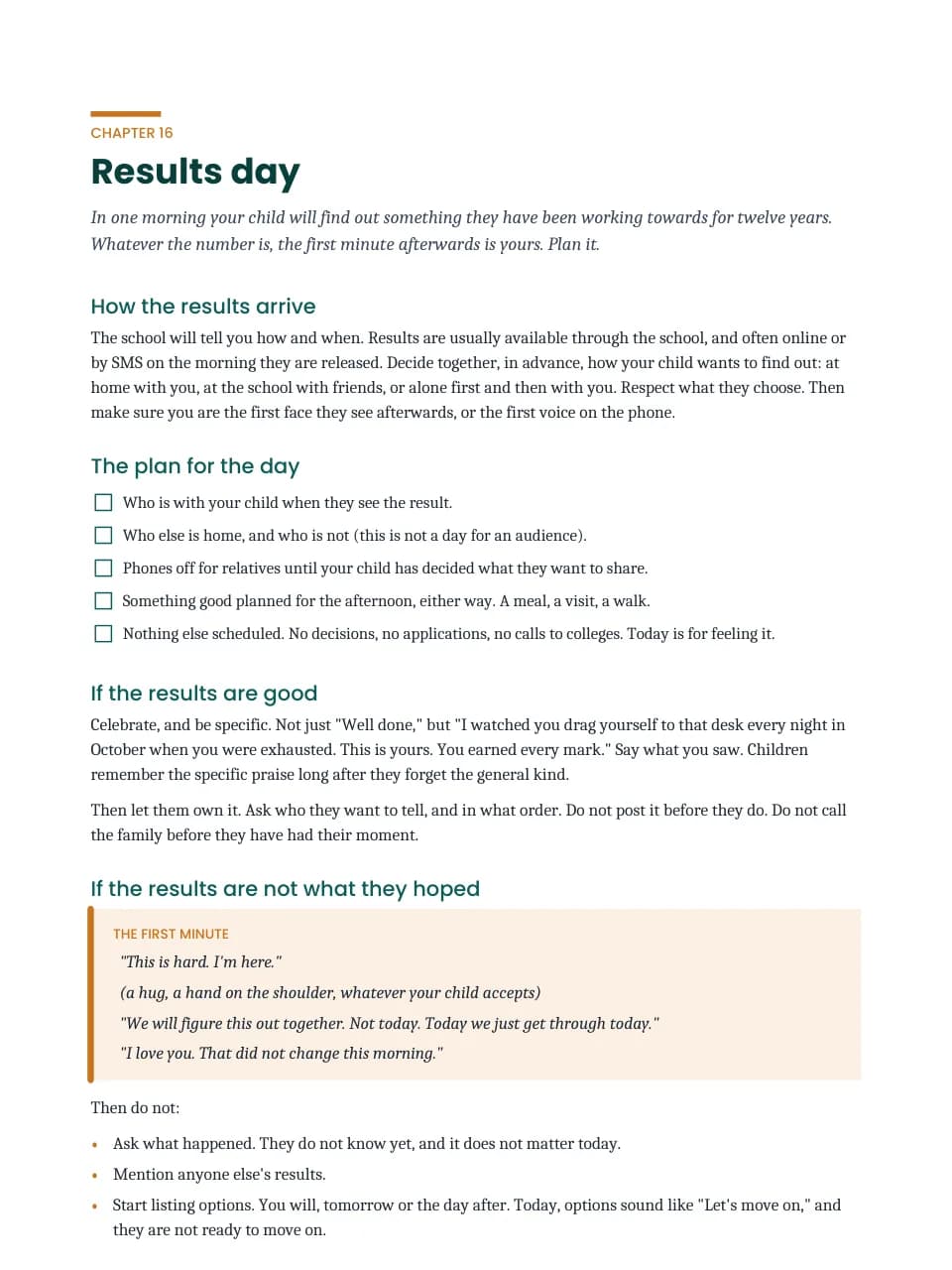
What this guide is not
- It is not a study guide. There are no past papers, revision timetables or exam tips. The school has that covered.
- It is not therapy, counselling or medical advice. It tells you when to get that help, and who to call.
- It is not one more task for your child. It is for you, the adult at home.
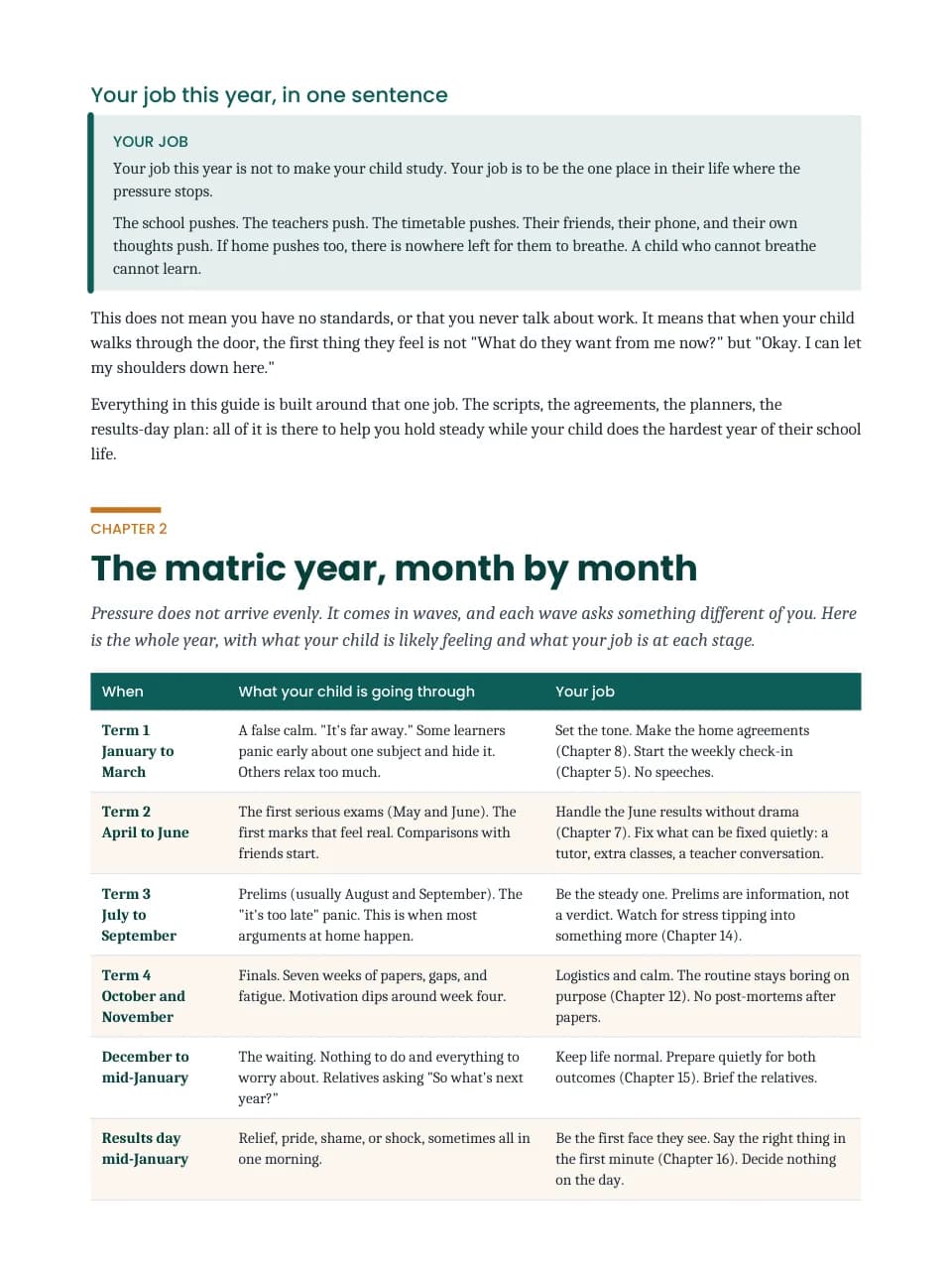
What the next few months ask of you
Pressure does not arrive evenly. It comes in waves, and each one asks something different of a parent. This is where the class of 2026 is now.
| When | What your child is going through | Your job |
|---|---|---|
| WhenFinals: 13 October to 26 November 2026 | What your child is going throughSeven weeks of papers, gaps and fatigue. Motivation is lowest around week four. | Your jobLogistics and calm. Keep the routine boring on purpose, and skip the post-mortem after each paper. |
| WhenThe waiting weeks: December to mid-January | What your child is going throughNothing to do and everything to worry about. Relatives asking “So what's next year?” | Your jobKeep life normal. Prepare quietly for both outcomes, and brief the relatives before the gatherings. |
| WhenResults day: mid-January 2027 | What your child is going throughRelief, pride, shame or shock, sometimes all in one morning. | Your jobBe the first face they see. Say the right thing in the first minute, and decide nothing on the day. |
Is your child in matric next year? The guide starts at Term 1 and covers the whole year, and it works best when you read it early.
What parents say
4.6out of 5from 30 parent reviews
Behind Every Matric
Be the calm one this matric season
Tutors and past papers help with the work. This guide helps with everything around it: a calmer home and a parent who knows what to say, which only you can give your child. Read it in one evening and use it tomorrow morning.
The full 47-page guide
20 short chapters. Read it through, or jump straight to the one you need tonight.
Word-for-word scripts
What to say after a bad mark, after a bad paper and in the first minute on results day.
Seven printable tools
The check-in card, home agreement, finals planner and more, made for the fridge.
The 2026 finals, week by week
Your one job in each of the seven exam weeks, plus the pass levels and helplines.
Discount price R299Regular price R499
You save R200 (40% off)
One payment. Yours to keep.
- Instant download, and emailed to you too
- Secure card payment through Yoco
- No subscription, nothing to cancel



“The guide gave me actual words to use when my son was stressed.”
Know another matric parent? Send them this page. It could make their year at home easier too.
Send this to another parentQuestions parents ask
No. There are no past papers, timetables or exam tips in it. This guide is for you. It covers the part of matric that happens at home: what to say, what never to say, how to handle a bad result, how to run the exam weeks, and what to do on results day.
No. The guide is built to be used by the calendar. Go straight to Part Four for your job in each of the seven exam weeks and what to do when a paper goes badly. The chapters on the waiting weeks and results day are still ahead of you.
Yes. This is the class of 2026 and 2027 edition. It starts at Term 1 and walks through the whole year, and the habits in it, like the weekly check-in and the home agreement, work best when you start early.
You can download it straight away on the confirmation page, and we email you the same link. The link works for 7 days and up to 5 downloads, so save the file to your phone or computer. If the link expires, you can ask for a new one with the email address you paid with.
Yes. You pay by card on Yoco's secure payment page. We never see or store your card details. With the matric season discount it is R299 once-off instead of R499, with no subscription and nothing to cancel.
Yes to both. It is a normal PDF that opens on any phone, tablet or computer. The seven tools at the back are made to be printed and stuck on the fridge.
No. It offers general parenting support and information, not therapy or medical advice. Chapter 14 explains the warning signs that stress has become something more, and lists the helplines to call. If you are worried about your child's safety right now, call the SADAG 24-hour line on 0800 567 567.
Be the one place in their life where the pressure stops
Matric season discount: R299 instead of R499. Instant PDF download, and the sooner you read it, the more of the year it can help with.